


Introduction: Long Call option strategy
The Long Call is a straightforward option strategy: you buy a call option when you expect the underlying asset to rise above the strike price before expiration. It offers defined risk (premium paid) and unlimited upside.
Construction
- Buy 1 Call Option (ATM – At the money- or slightly OTM – Out of the money)
Leverage
Buying a call provides leverage: with a relatively small premium, you control 100 shares. If price rises, the option’s value typically grows faster percentage-wise than the stock.
⚠️ Options decay with time. If price fails to exceed strike by expiration, the call can expire worthless.
Payoff (Concept)
- Unlimited profit if price surges far above the strike.
- Maximum loss limited to the premium paid if price finishes at or below strike.
Profit Potential
Maximum Profit: Unlimited

Occurs when: Underlying settles above Strike + Premium
Formula:
Profit = Underlying Price − Strike Price − Premium Paid
Loss Potential
Maximum Loss: Premium Paid (+ commissions)
Occurs when: Underlying ≤ Strike at expiration
Breakeven
Breakeven = Strike Price + Premium Paid
Example Trade Long Call Option strategy
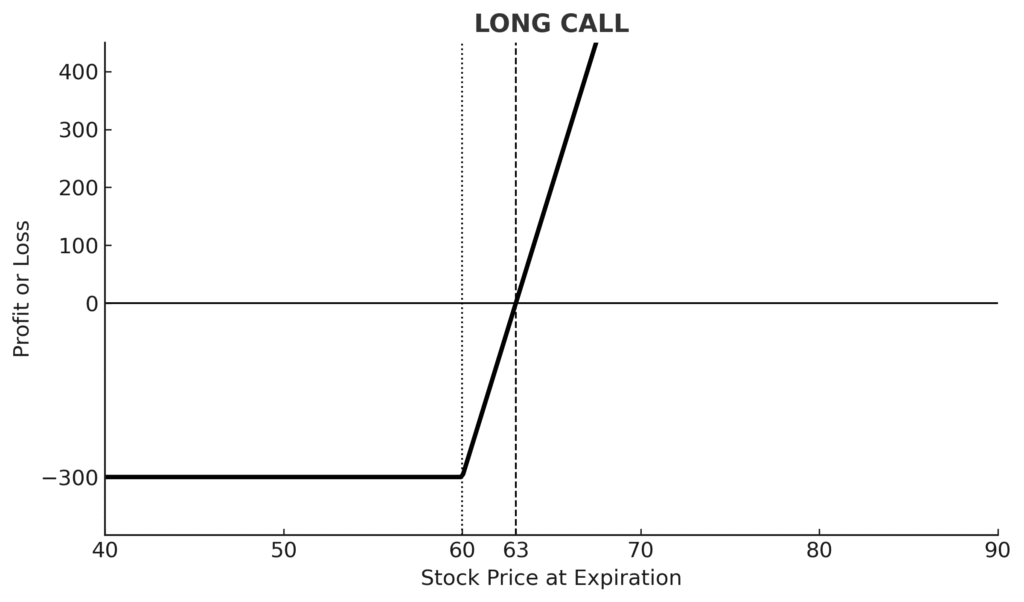
Assume ABC trades at $60. You buy a $60 call expiring in 1 month for $3 ($300 per contract)
- If ABC closes at $70: intrinsic value = $10 × 100 = $1,000 → Net profit = $1,000 − $300 = $700.
- If ABC closes at $55: option expires worthless → Max loss = $300.
- If ABC closed at $63: Breakeven
Note
Each option contract controls 100 shares of the underlying. That’s why all profit and loss values in the payoff diagram are multiplied by 100. For instance, a $3 premium equals $300 per contract.
Pros & Cons
Pros
- Defined risk (premium only)
- Unlimited upside
- Simple execution
Cons
- Time decay works against the buyer
- Needs a meaningful move to overcome premium
- Entire premium at risk if thesis fails
Quick Facts
| Parameter | Value |
|---|---|
| Outlook | Bullish |
| Profit Potential | Unlimited |
| Loss Potential | Limited to premium |
| Credit/Debit | Debit (you pay premium) |
| No. of Legs | 1 |
Note
This strategy applies to stocks, ETFs, indices, and futures options. Commissions/fees vary by broker and reduce returns.
FAQ
1. When should I use a Long Call option strategy?
A Long Call Option Strategy is best used when you expect the underlying asset to rise significantly within the option’s lifetime. Traders often buy long calls ahead of earnings announcements, product launches, or in bullish markets where momentum is strong. It allows you to participate in upside moves while keeping risk defined and limited to the premium paid.
2. Is a Long Call option strategy better than buying shares?
Buying shares gives you ownership and no expiration, while a Long Call offers leverage with less capital required. For example, controlling 100 shares via a call option may cost a few hundred dollars versus thousands for the stock. However, unlike shares, options expire, so timing matters. A Long Call is better if you expect a sharp, short-term move.
3. Can I lose more than the premium?
No. The maximum loss on a Long Call Option Strategy is limited to the premium you paid, plus transaction fees. Even if the stock collapses to zero, your call option simply expires worthless. This defined-risk feature makes the Long Call attractive for traders who want bullish exposure with limited downside.
4. What hurts a Long Call option strategy the most?
Two main factors hurt Long Calls: time decay and implied volatility drops. Time decay means the option loses value each day as expiration approaches if the stock does not move. A volatility drop can also lower the option’s price, even if the stock goes slightly higher. Both factors can erode profits if the expected move does not happen quickly.
5. Can I close the trade before expiration?
Yes. You don’t have to hold a Long Call until expiration. You can sell the option anytime in the market to lock in profits or reduce losses. Many traders exit early when their target is reached, or when time decay starts to accelerate, to avoid losing premium unnecessarily.
6. What is the breakeven point on a Long Call?
The breakeven point equals the strike price plus the premium paid. For example, if you buy a $50 strike call for $2, your breakeven is $52 at expiration. At that level, your profit on the option exactly offsets the cost of the premium, so you neither gain nor lose money. Any price above that results in net profit.
7. Can I combine a Long Call with other strategies?
Yes. A Long Call can be the foundation for more advanced strategies. For example, combining a Long Call with a Short Call creates a Bull Call Spread, which reduces the cost but caps profits. Adding a Put may create a synthetic position similar to owning the stock. These variations help adapt risk/reward to different market views.
8. Why choose a Long Call instead of a Bull Call Spread?
A Long Call provides unlimited upside, while a Bull Call Spread caps your profits but reduces the premium paid. Traders choose Long Calls when they expect a very strong move, while spreads are better when the outlook is moderately bullish but cost control is a priority.


