- Strategy Essentials
- Overview of Zero-cost collar option strategy
- Construction of the Zero-Cost Collar option strategy
- Profit and Loss Characteristics of a zero-cost collar option strategy
- Example — Building a Zero-Cost Collar
- Payoff Summary Table
- Payoff Diagram of Zero-Cost Collar Option Strategy
- Commission Impact
- Zero-cost collar option Strategy – Strategic Insights
- Greek Sensitivities (Greeks Analysis)
- Practical Applications
- Comparison with a Regular Collar
- Summary
- FAQ — Zero-Cost Collar Option Strategy
Strategy Essentials
Construction: Long 100 shares + Sell 1 Out-of-the-Money (OTM) Call + Buy 1 At-the-Money (ATM) Put, same expiration
Maximum Profit: Limited (difference between short call strike and stock purchase price, plus net credit if any)
Maximum Loss: Limited (difference between purchase price and long put strike, minus any net credit received)
Breakeven Point: Purchase price of the underlying adjusted by net premium paid or received
Best Market Context: Moderately bullish or neutral markets where the investor seeks downside protection with no net option cost
Complexity Level: Beginner to intermediate (requires understanding of covered calls and protective puts)
Overview of Zero-cost collar option strategy
The Zero-Cost Collar option strategy (also called a Costless Collar) is a powerful risk-management options strategy designed to protect a stock position without spending additional capital on option premiums. It is ideal for bullish or moderately bullish investors who already own shares but want to lock in profits or limit downside risk — all while paying no net premium for the protection.
In simple terms, the investor buys a protective put and sells a covered call at the same time, structuring both so that the premiums offset each other. The result is a position that costs nothing to establish, hence the term “zero-cost.”
This strategy appeals to disciplined investors who prioritize capital preservation over maximum gains. It allows one to stay invested while defining both the floor (downside protection) and ceiling (profit cap) of their trade.
Depending on the volatility of the underlying, the call strike can range from 30% to 70% out of money, enabling the writer of the call to still enjoy a limited profit should the stock price head north. This strategy is mainly executed using LEAPS® options because the strike price of the call sold is mostly rather high in relation to the price of the underlying

Construction of the Zero-Cost Collar option strategy
To build a zero-cost collar option strategy, an investor combines the following legs:
- Buy 100 shares of the underlying stock (or already own them)
- Sell 1 OTM LEAPS Call (Out-of-The-Money, Long-Term Equity Anticipation Security)
- Buy 1 ATM or slightly OTM LEAPS Put
Both the call and put share the same expiration date : same expiration month and year (long-dated, often 6-18 months out) and typically the same number of contracts. The strike prices are chosen so that the premium received from the call equals the cost of the put — making the collar “costless.”
Example of structure:
- Underlying: 100 shares of stock
- Sell 1 Call (above current price)
- Buy 1 ATM or slightly OTM Put (strike near or slightly below current price)
- Net premium = approximately $0
The strategy can also be used with ETF options, index options, or even futures options — as long as the mechanics of premium offset remain consistent.
Profit and Loss Characteristics of a zero-cost collar option strategy
The zero-cost collar option strategy defines a limited risk and a limited reward range. It’s essentially a protective wrapper around an existing long position.
Maximum Profit (Capped)
Profit is capped because of the short call, which obliges the investor to sell their shares at the strike price if the stock rallies strongly.
Formula:
Max Profit = Strike Price of Short Call - Stock Purchase Price + Net Premium - Commissions
Profit is achieved when the stock closes at or above the strike price of the call.
Maximum Loss (Limited)
The long put ensures downside protection. Even if the stock falls sharply, the put acts as insurance, establishing a minimum exit price.
Formula:
Max Loss = Stock Purchase Price - Strike Price of Long Put - Net Premium + Commissions
Maximum loss occurs when the stock closes at or below the strike price of the put.
Breakeven Point
Because this collar is set up at no cost, the breakeven is almost identical to the purchase price of the stock.
Formula:
Breakeven = Stock Purchase Price ± Net Premium (≈0)}
Example — Building a Zero-Cost Collar
Let’s walk through a complete example.
Scenario:
You own 100 shares of ABC stock, currently trading at $90. You want to protect your position against downside risk over the next month but don’t want to spend cash on insurance.
You decide to create a zero-cost collar using the following options expiring in June:
- Sell 1 June 100 Call @ $3.00
- Buy 1 June 85 Put @ $3.00
Net Premium = $0 (Costless)
You already own 100 shares, so this strategy costs nothing to initiate.
1️⃣ At Expiration — Stock Falls to $80
- The 85 put becomes in the money and protects you.
- The call expires worthless.
- You exercise the put and sell your shares for $8,500.
Loss:
You initially paid $9,000 for the stock and receive $8,500 → $500 max loss.
That’s your defined downside risk.
2️⃣ Stock Stays Flat at $90
- Both the call and the put expire worthless.
- You keep your 100 shares.
- The total position value remains $9,000.
No profit, no loss — just protection that cost nothing.
3️⃣ Stock Rises to $100 or Above
- The call you sold becomes in the money.
- Your shares are called away at $100 each.
Result:
You sell your 100 shares for $10,000.
Since you bought them for $9,000, your maximum profit = $1,000.
Beyond $100, you do not participate in additional upside — profit is capped.
Payoff Summary Table
| Stock Price at Expiration | Short 100 Call | Long 85 Put | Net Stock Value | Total P/L |
|---|---|---|---|---|
| $80 | $0 | +$500 | $8,500 | –$500 (Max Loss) |
| $85 | $0 | $0 | $8,500 | –$500 |
| $90 | $0 | $0 | $9,000 | Break-even |
| $95 | $0 | $0 | $9,500 | +$500 |
| $100 | –$1,000 | $0 | $10,000 | +$1,000 (Max Profit) |
| $105 | –$1,500 | $0 | $10,000 | +$1,000 (Capped) |
Interpretation
The payoff pattern forms a defined corridor between the put and call strikes.
- The put ensures a safety floor.
- The call limits potential gains but finances that protection.
- The investor stays exposed to moderate upside but is insulated from sharp declines.
Essentially, it’s a free insurance policy funded by limiting profits above a chosen ceiling.
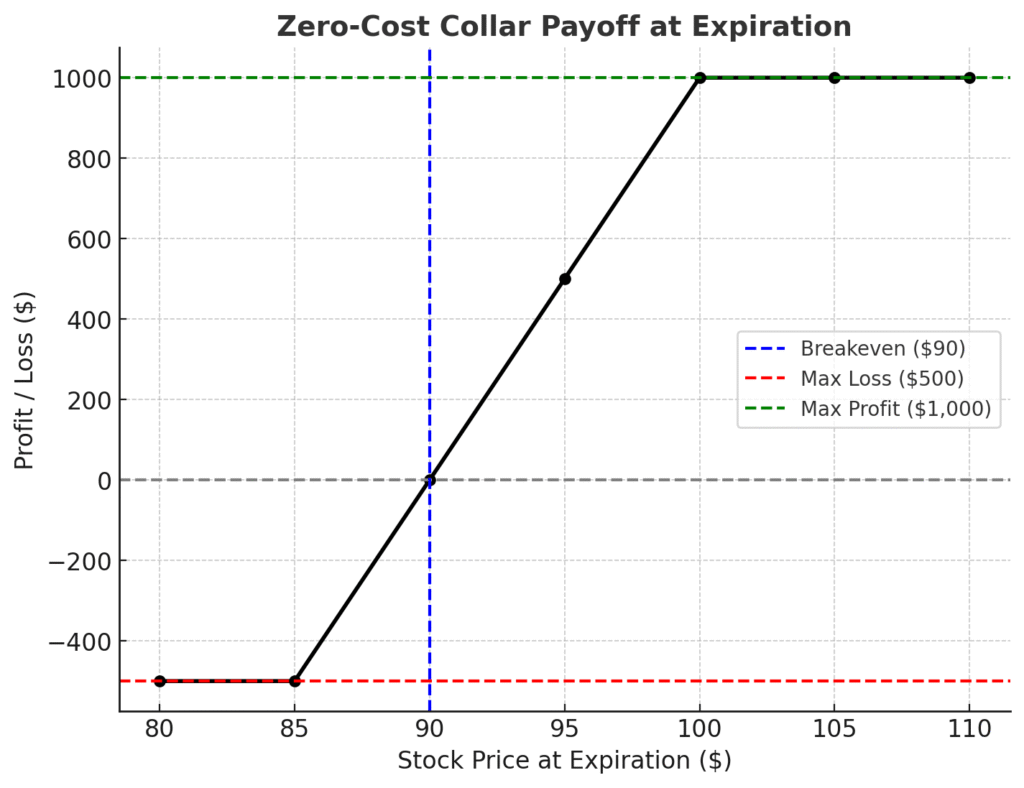
➡️ Clear pattern:
- Max Loss: $500 (at $85)
- Breakeven: $90
- Max Profit: $1,000 (at $100 or higher)
The payoff shape resembles a horizontal corridor — with a flat floor representing downside protection, a capped ceiling limiting profits, and a neutral middle zone around the breakeven point.
Payoff Diagram of Zero-Cost Collar Option Strategy
Commission Impact
While this is called a zero-cost collar, commissions still apply.
Assume $0.65 per contract — with two contracts, total cost ≈ $1.30.
That’s negligible compared to the protection value it offers. Still, active traders should choose low-fee brokers to avoid long-term drag.
Zero-cost collar option Strategy – Strategic Insights
Best Market Context
- Moderately bullish to neutral outlook.
- You expect the stock to hold steady or rise slightly, not surge dramatically.
- Ideal after a strong rally, when you wish to lock in unrealized gains.
Advantages
- Zero cost to establish.
- Downside protection from the put.
- Income generation from the short call.
- Emotion-free framework — clearly defines worst- and best-case outcomes.
Limitations
- Capped upside: profits stop at the short call strike.
- Assignment risk: if the stock exceeds the call strike, your shares are called away.
- Not suitable for speculative traders seeking unlimited gains.
Greek Sensitivities (Greeks Analysis)
| Greek | Effect on the Strategy |
|---|---|
| Delta | Net delta is positive but capped. As the stock rises, delta decreases due to the short call. |
| Gamma | Moderate, as both long and short options offset rapid delta changes. |
| Theta | Slightly positive, since the sold call collects more premium decay than the long put loses. |
| Vega | Neutral to slightly negative — rising volatility helps the put but hurts the call. |
| Rho | Minimal effect unless rates move drastically. |
The strategy thus behaves like a softly bullish covered position — stable and predictable.
Practical Applications
- Protecting Gains: Investors who have seen large unrealized profits can lock in a price range without selling shares.
- Low-Volatility Periods: Costless collars are useful when volatility is balanced, making premiums easy to offset.
- Retirement Accounts: Perfect for portfolios needing downside control without continuous monitoring.
- Corporate or Fund Hedging: Common among fund managers to stabilize quarterly performance.
Comparison with a Regular Collar
| Feature | Standard Collar | Zero-Cost Collar |
|---|---|---|
| Net Premium | Debit or Credit | ≈ 0 |
| Objective | Income + Protection | Protection Only |
| Capital Required | Higher | Neutral |
| Market Outlook | Mildly Bullish | Mildly Bullish / Neutral |
| Risk | Limited | Limited |
| Reward | Limited | Limited |
The zero-cost collar is a refined version of the traditional collar — designed to maximize efficiency with no out-of-pocket expense.
Summary
The Zero-Cost Collar Strategy offers one of the most elegant risk/reward balances in options trading.
It transforms a long stock position into a defined-outcome investment, protecting capital at no net cost while maintaining modest upside exposure.
Key takeaways:
- You can sleep at night knowing your loss is capped.
- You stay invested in the market with zero premium outlay.
- You sacrifice excess upside but gain peace of mind.
This is why the zero-cost collar remains a staple among institutional investors, fund managers, and conservative traders who value certainty over speculation.
FAQ — Zero-Cost Collar Option Strategy
Q1. What is a Zero-Cost Collar option stategy?
A hedging strategy combining a long stock position, a long put, and a short call where the premium received from the call finances the cost of the put.
Q2. Why is it called “costless”?
Because the call premium offsets the cost of the protective put, resulting in little to no net premium outlay.
Q3. Who typically uses this zero cost collar option strategy?
Conservative investors, fund managers, and institutions who need capital protection while staying invested.
Q4. Is the profit really capped?
Yes. Once the stock rises above the short call strike, additional gains are forfeited.
Q5. What happens if the stock skyrockets?
Your shares will be called away at the call strike, limiting your upside to the maximum profit.
Q6. Can I use this strategy without owning stock?
No. A short call requires you to hold the underlying shares (covered call).
Q7. Is the Zero-Cost Collar option strategy good for volatile markets?
It works best in moderately bullish or stable conditions. Extreme volatility may distort the balance between premiums.
Q8. Can I still lose money?
Yes, but losses are capped by the long put. The maximum loss equals the difference between purchase price and put strike.
Q9. Can I adjust the strikes later?
Yes. You can roll up or down the put and call strikes if market conditions change.
Q10. Is margin required?
Only for the short call, but since it’s covered by stock ownership, margin impact is minimal.
Q11. What if the stock pays dividends?
You still collect dividends as long as you hold the shares, unless they are called away.
Q12. Can this strategy be used with ETFs?
Yes. Many traders use zero-cost collars on ETFs due to high liquidity and diversification.
Q13. How does implied volatility affect it?
Higher volatility increases the cost of the put but also raises call premiums, making collars easier to balance.
Q14. When is this zero cost collar option strategy not recommended?
During strong bull markets — you’ll regret missing out on unlimited upside.
Q15. What’s the difference between a Zero-Cost Collar and a Protective Put?
A protective put requires paying a premium. A collar offsets that cost with a short call.
Q16. What’s the difference between a Zero-Cost Collar option strategy and a Covered Call?
A covered call caps upside but leaves downside open. A collar adds a put for protection.
Q17. Can I use this strategy in retirement accounts?
Yes. It’s compliant for IRAs and other retirement portfolios because risk is defined.
Q18. How long should I hold a collar?
Typically one to three months, aligned with option expiration cycles.
Q19. Can I trade collars intraday?
No. Collars are designed for position management over weeks or months, not short-term trading.
Q20. Is it really free?
Yes, aside from small commissions. In practice, the cost is very close to zero, hence “costless.”